


Feasibility Analysis Provides a Fact-Based Foundation for an Adobe Workfront Decision
A leading German business software provider evaluated Adobe Workfront as a central platform for communications, marketing, and sales planning. Prime Force assessed 30 requirements for their technical and functional feasibility. This created a reliable basis for the decision and the potential development of an MVP.
Fact-Based Foundation for an Adobe Workfront Decision
A leading German provider of software and services for tax advisors, auditors, and businesses wanted to make the planning and management of its communications, marketing, and sales activities more structured, transparent, and topic-focused. Strategic goals, thematic priorities, operational activities, and performance tracking had previously been managed across several separate tools, resulting in noticeable process fragmentation and limited visibility for the teams involved. Adobe Workfront was identified as a potential central planning and management platform. Before deciding whether to implement it, however, the company wanted an independent, fact-based answer to one key question: Does Workfront actually meet its requirements?
Prime Force was commissioned to answer this question through a structured feasibility analysis — explicitly without any commitment to implementation.
Step by Step
Based on a detailed requirements catalog provided by the client’s project team, Prime Force consultants — with extensive experience in business analysis, process design, and Adobe Workfront — assessed each individual requirement. Every requirement was evaluated for its technical, functional, and organizational feasibility and documented in writing; where appropriate, the team also developed alternative solution approaches.
To establish a solid basis for the assessment, the team conducted discovery sessions with the client’s process owners, IT teams, and business units and analyzed existing processes, roles, systems, and the current tool landscape. These findings directly informed the feasibility assessment and effort estimation.
For each requirement, the team assessed complexity and effort, evaluated its suitability for an initial MVP scope, and identified both technical and organizational risks. In parallel, all assumptions underlying the assessment were documented, providing a clear basis for prioritization and recommendations on the next steps. As part of the analysis, the team also assessed the integration requirements for relevant third-party systems within the client’s system landscape.
All findings were consolidated into a structured report and presented to the stakeholders in a dedicated results presentation, followed by a Q&A session several weeks later, giving the team sufficient time for internal review.
Results
The analysis covered 30 detailed requirements across communications planning, campaign and task management, budget control, access management, and integration with the client’s existing system landscape.
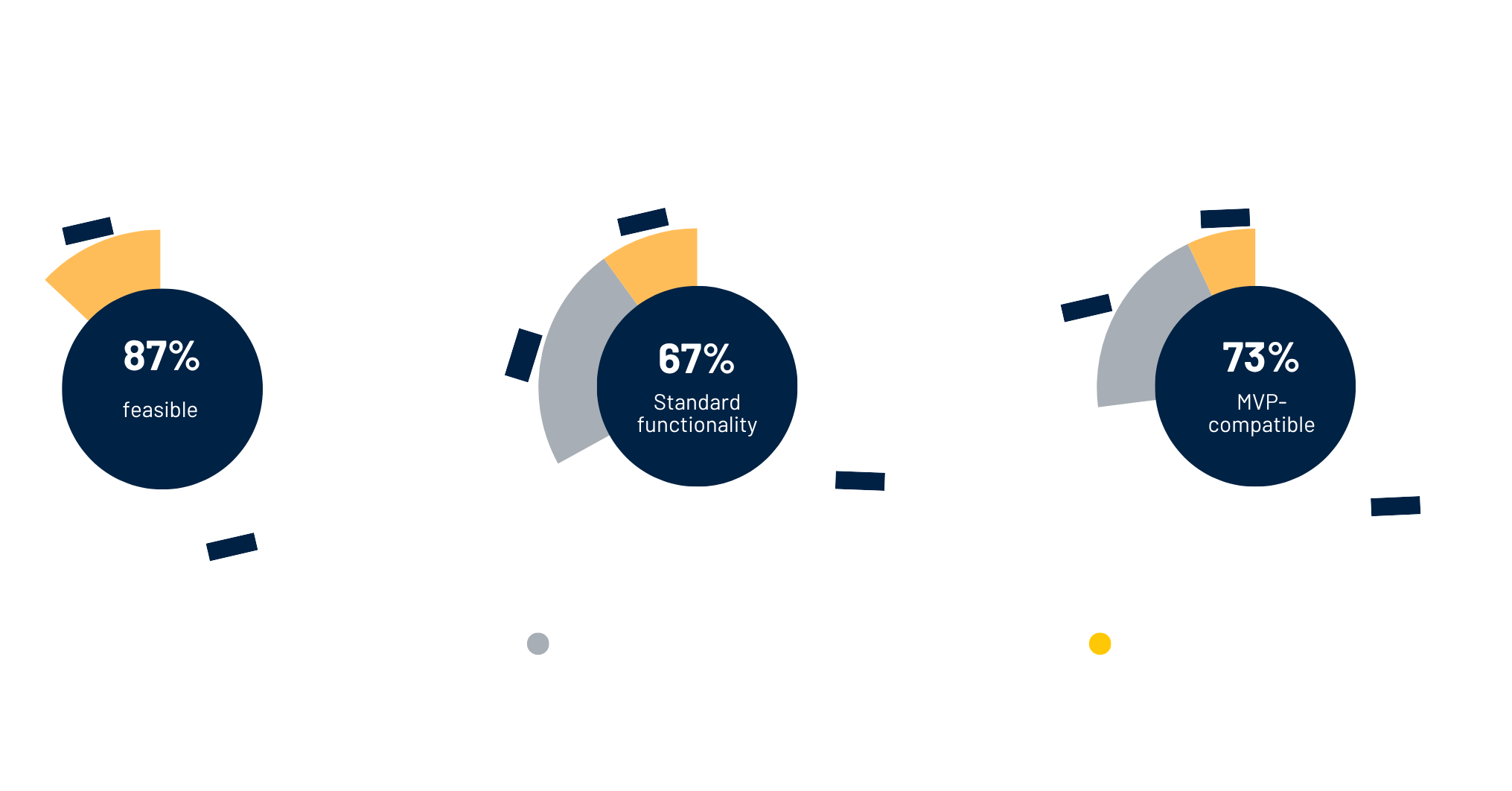
- 87% of requirements (26 out of 30) were assessed as fully feasible, while the remaining 13% (4 out of 30) were considered partially feasible — not a single requirement was classified as infeasible
- Two-thirds of the requirements (67%) can be addressed using Workfront’s standard functionality; an additional 10% can be covered through native automation with Workfront Fusion, while the remaining requirements require targeted integration work
- 73% of requirements were considered suitable for an initial MVP scope, providing a realistic foundation for a first rollout phase
- Complexity varied significantly: from requirements that could be configured quickly to a smaller group of complex requirements, primarily involving cross-system integrations and reporting
- The licensing analysis identified the Planning and Fusion add-ons as particularly relevant; Data Connect was considered worth evaluating depending on the need for BI integration
Results at a Glance – 30 Requirements Assessed
In-Depth Insights: Integration, AI, and Risks
Beyond the requirements assessment, the team took a closer look at the areas where decision-makers typically face the most critical questions.
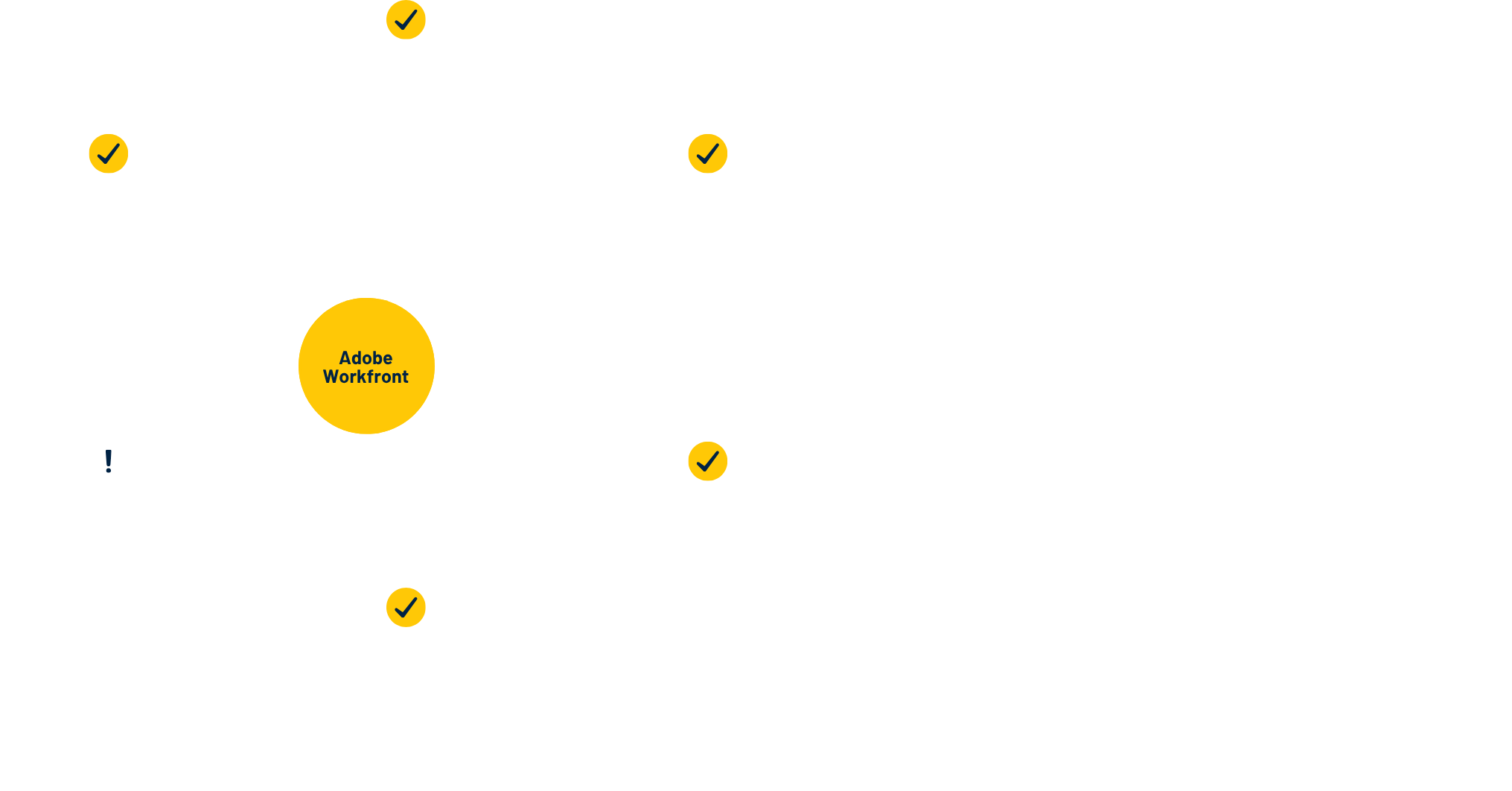
Integration Analysis: As part of an in-depth review of the system landscape, the team assessed eleven existing tools and integrations — ranging from collaboration and communication tools to marketing, social media, and BI systems. Integrations could be implemented for eight of them, primarily through native connectors or the Fusion add-on. For two existing systems, integration was not possible due to missing or undocumented interfaces — a fact that was identified early and could therefore be factored into further planning
- AI Capabilities: The team also evaluated Adobe Workfront’s AI capabilities, from automated summaries and context-aware search to AI-supported data management in the Planning add-on. A new question that emerged during the project regarding how AI features handle sensitive data was incorporated directly into the assessment — a good example of how the analysis could respond to emerging topics rather than rigidly following the original requirements catalog
- Functional Demo: In addition, the team built a demo environment using real Workfront interfaces — from request and planning views to automated reporting dashboards — giving stakeholders a tangible understanding of how the platform actually works rather than simply describing its capabilities
- Risk Management: For the key risk areas — data model and system architecture, system and integration dependencies, process and governance requirements, and implementation effort — the team developed specific mitigation measures, such as establishing a defined object hierarchy and a clear roles and permissions concept as the foundation for consistent integrations
Integration Landscape Around Adobe Workfront
From Analysis to Roadmap
The feasibility analysis went beyond a pure assessment: It provided the foundation for a concrete, resource-planned roadmap for a potential implementation — from refining the MVP scope and developing the detailed functional concept to configuration, testing, training, and rollout, followed by post-go-live support and further development.
In a short period of time, an independent assessment became an actionable, jointly agreed project plan — providing management and business teams with the transparency they needed to understand where Adobe Workfront fits, where configuration or integration is required, and what a realistic first project phase could look like.